What’s “brain-apparatus communication”?
lFirst, our brain is based on the body for various supports
Mind-body, Body-mind communications
|
ØThe physiological brain is not isolated, but communicate with the internal “organs” all the time ØHealthy brain relays on “harmonious communication” thus get enough support from the organs ØBrain science should take care of the internal environment which support our brain |
lSecond, we are curious animals
Communicate with the environment all the time, want to understand and dominate the world
|
Face world challenge, update our brain ØComplex and dynamic environment challenge the brain, develop and regulate the brain Understand and beautify the world ØCommunication promotes learning, increases goodwill and friendship ØInteraction may produce better technology and products |
lThird, we need both of the above: communicate with internal and outworld simultaneously
üwell state and harmonic interaction make us physiological health
ühealth let us actively explore the outside to get more resources (psychological well)
üand more resources promote physiological health further (positive feedback)
 |
Summary (3 interactions) uBAC3: BAC2*BAC1 (integration) uBAC2: brain-non-living apparatus (Brain-computer interface etc.) uBAC1: brain-living apparatus (Psychosomatic medicine etc.) |
The contents of BAC (examples)
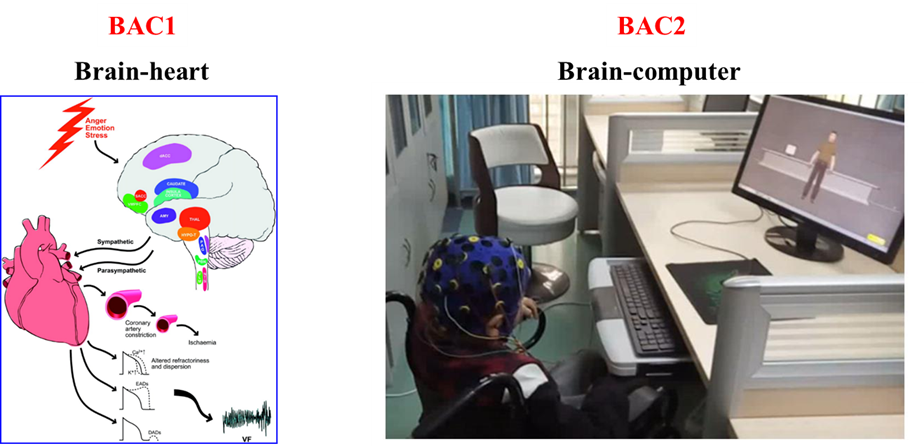
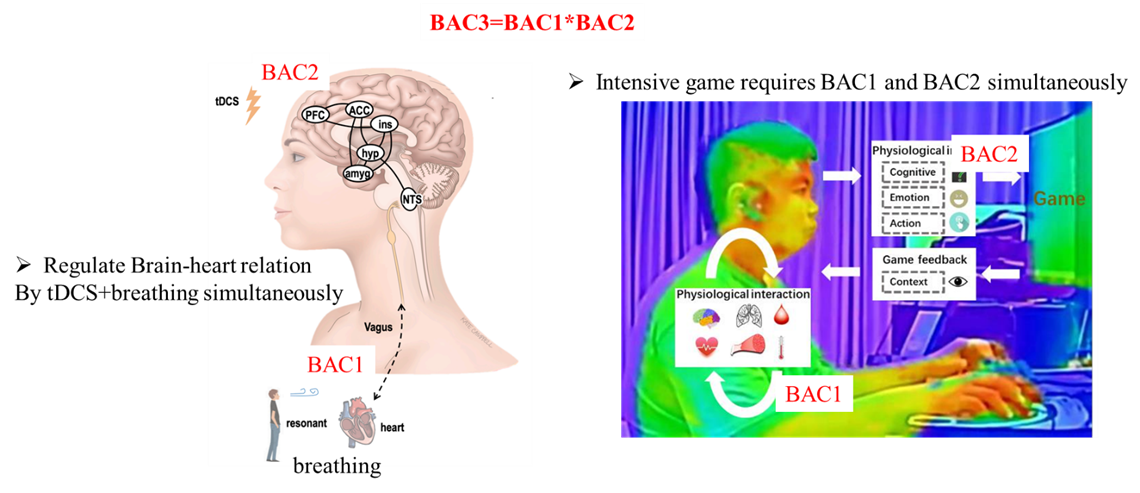
The contents of BAC
Four parts of BAC journal
ØBrain (BAC0)
ØBrain-living apparatus (BAC1)
ØBrain-non-living apparatus (BAC2)
ØIntegration of BAC1 and BAC2
Primary Introduction:
uD Yao, Y Qin & Y Zhang (2022). From psychosomatic medicine, brain–computer interface to brain–apparatus communication, Brain-Apparatus Communication: A Journal of Bacomics, 1:1, 66-88, DOI: 10.1080/27706710.2022.2120775
uD Yao, Y Zhang, T Liu, et al (2020). Bacomics: a comprehensive cross area originating in the studies of various brain-apparatus conversations. Cognitive Neurodynamics, 14(4):425–442
uY Qin, T Liu, D Yao (2021). Bacomics–a new discipline integrating brain and the outside. Sheng Wu Yi Xue Gong Cheng Xue Za Zhi. 38(3): 507–511 [秦云,刘铁军,尧德中.脑器交互学——脑与外界协同的新学科(生物医学工程学杂志2021年6月第38卷第3期)]
Web information of “Brain-Apparatus Communication”
The Journalhttps://www.tandfonline.com/journals/tbac20
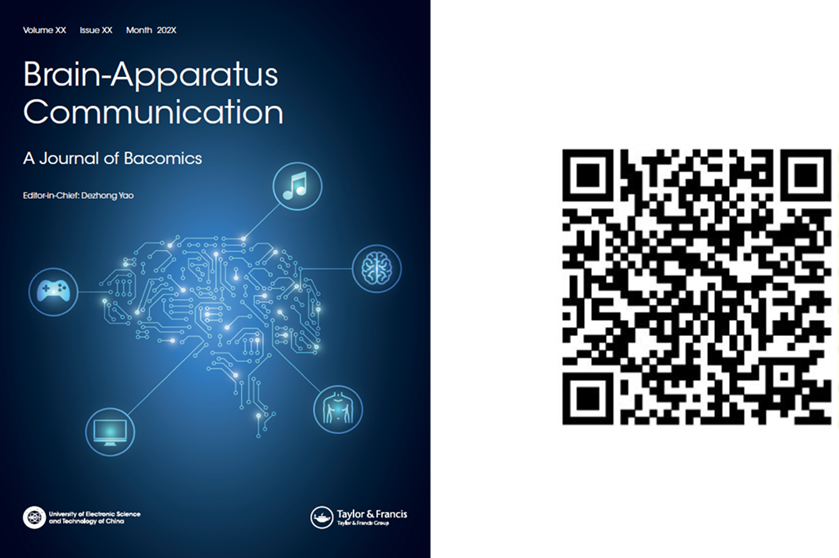
Editor-in-Chief
Dr.Dezhong Yao |
Dr. Yao is a distinguished professor at the University of Electronic Science and Technology of China (UESTC). He is the founder and Director of the Key Laboratory for NeuroInformation of Ministry of Education (MOE) of China (2009-), the International Joint Research Center for NeuroInformation of Ministry of Science and Technology of China (2013-), and the founder and Dean of the School of Life Science and Technology at UESTC (2001-2017). Dr. Yao obtained several international and national awards and honors, including Roy John Award of Electroencephalography and Clinical Neuroscience Society, Fellow of American Institute for Medical and Biological Engineering (AIMBE), Most Cited Chinese Researchers of Elsevier (each year 2014 to 2018), Top 2% scientist in Neuroscience in both lists of “Career” and “Single Calendar Year”, Distinguished Young Scholars of China Natural Science Foundation, and ChangJiang Scholars Professor of MOE, Natural Science Award of MOE, and National Excellent Teachers of MOE. Main contributions: (1)Original zero reference of EEG and ERP (REST); (2)Conceived the concept “Brain-apparatus communication/interaction/conversation” (BAC). Contact at:bac@uestc.edu.cn https://scholar.google.com/citations?user=ClUoWqsAAAAJ&hl=en&oi=ao |
Other information
www.google.comsearch “brain-apparatus communication”
www.baidu.comsearch “脑器交互(学) ”